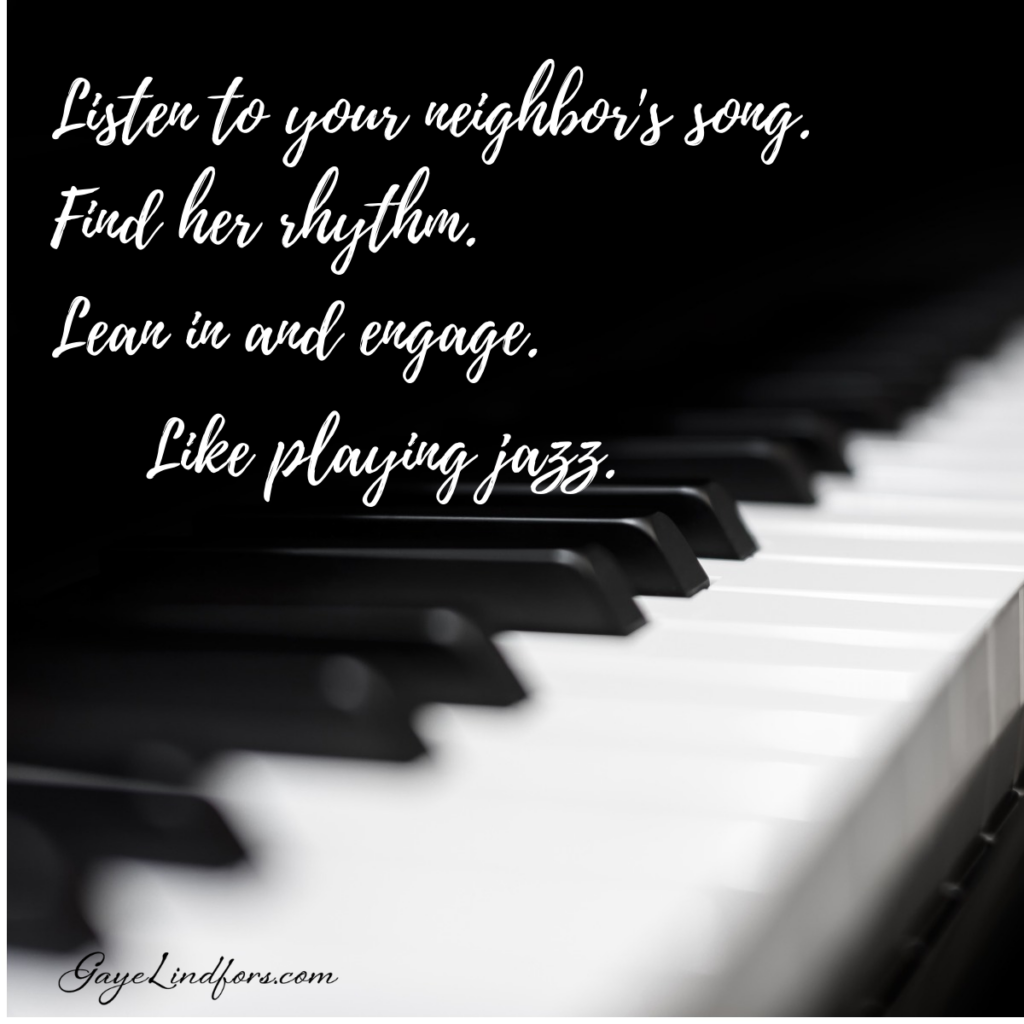
The music world recently said good-bye to one of our greatest jazz musicians, Ramsey Lewis. He didn’t just play the keys on the piano. He turned the piano into an instrument of emotion, melody, and rhythm. He leaned in and felt the music.
This note of encouragement was written a few years ago, and I included it in Getting My Ducks in a Row and Other Stories of Faith. Today I share it in his memory, with gratitude for the joy, inspiration, and life lessons he taught me.
Good grief. I took them all so very seriously…
The piano competitions.
(You’d think that my entire life depended on playing Für Elise without a mistake.)
Months of practicing all boiled down to five minutes in a noise-less room that echoed when you pulled the piano bench forward on the wood floor, empty except for a baby grand piano, an oblong table with judges sitting behind it on folding chairs with pencils raised, and a few extra chairs for the very anxious parents.
The competition. The judges. The nerves. The desire and need to play the song just perfectly.
I simply adore piano music; playing it and listening to it. It’s always been easy to feel the emotion—to bring life and energy from the keys. Knowing what notes to play, I have an ear for embellishing on those notes – adding more emotion and extra keys. But it is always starts with the notes.
Not so with jazz.
I really wish I could play jazz.
In jazz, you let your soul lead, rather than the notes. You feel it, rather than playing it right.
Watching my favorite pianist Ramsey Lewis play jazz with his combo – he takes my heart and soul to a place that sings and tingles and smiles. His long fingers literally skim the ivories. His right leg bounces up and down as he feels the rhythm. Improvising as he responds to the other musicians. Glancing at the bass player and giving him a grin that says, Oh, yeah. That sounded good. He becomes part of something that is bigger than himself, deeper than what he’s feeling. He’s part of an ensemble that is listening intently to each other while making amazing music.
“Like playing jazz” describes how I want to love my neighbors.
It’s too easy to expect everyone to live by the same rules. (Usually our rules, right?) By the written notes. These “rules” frame issues that are complex and encourage us to take sides.
When those rules are broken, and notes are missed, we start to believe that we aren’t as good as we should be. That the other person isn’t as good as she should be.
We count the wrong notes, rather than ignoring the notes and listen instead to the music.
It’s easier to live in a world where there are right notes that are supposed to be played. Where judges identify and call out the mistakes. Because we believe we need to know who is right and who is wrong. We tell our neighbor that her song is the wrong song. It’s not the song we understand so it must not be right.
We miss out on the very best music when we play as if we were in a command performance that requires perfection. When we expect that from our neighbor. When we appreciate only the right notes. When we miss the music, the heart, the relationship, the connection, the combo.
But.
We are called to love. To show grace. To forgive. To listen to our neighbor’s song, find her rhythm, and listen to her music as a way of getting to know her. We are called to invite others into knowing and loving Jesus, rather than telling them where they don’t measure up. We sit with her on the piano bench rather than at the judge’s table.
I’m learning to listen for the melody and syncopation and harmony in my neighbor’s music in all its glorious noise and messiness.
I’m learning how to get to know her.
I’m learning to listen to her heart.
I’m learning to love my neighbor.
P.S. Do you have a neighbor or friend that could use some encouragement? How about giving her one of my books just to say, I’m thinking about you. So glad we’re friends. Pick out your favorite here!